




NIH Program on Health and Extreme Weather
Research Coordinating Center
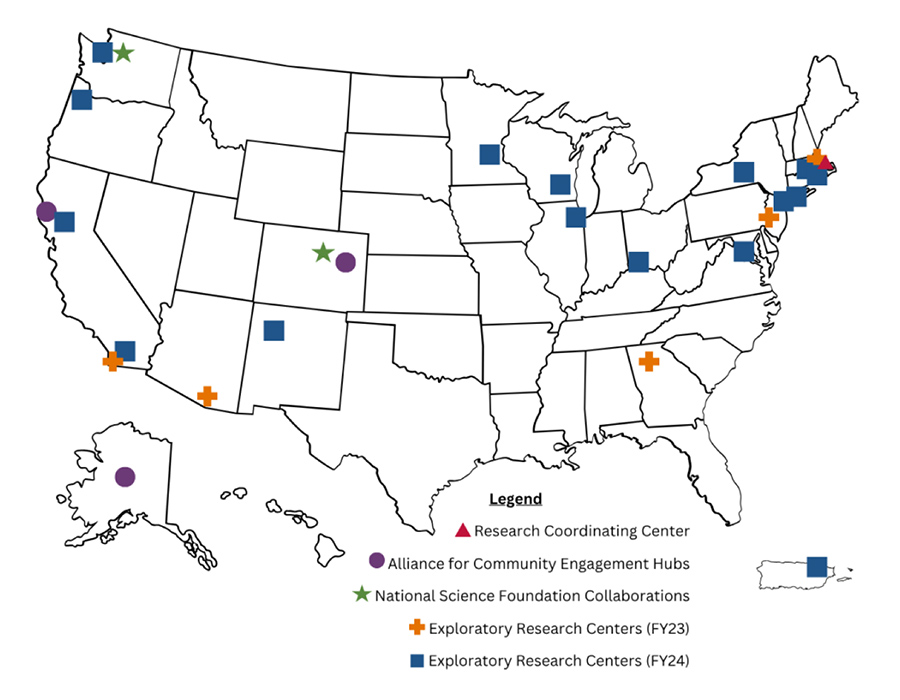
NIH has funded a research coordinating center led by the Boston University School of Public Health and Harvard T.H. Chan School of Public Health. This research coordinating center—called CAFE—aims to Convene, Accelerate, Foster, and Expand the health and extreme weather community of practice, both in the US and globally. CAFE offers a wide array of resources and opportunities for researchers. CAFE provides a research matchmaking tool, CAFE Dataverse and coding resources, an educational resource hub, events, and so much more.
Exploratory Research Centers

The NIH HEW Program provided funding to establish exploratory research centers to foster and sustain transdisciplinary teams that can explore various approaches to address the complex impacts of extreme weather on health. Each center is anchored by a central theme and is focused on generating new knowledge and developing new, action-oriented strategies that protect health and build resiliency at the individual, community, national, and global levels. These centers are funded by P20 grant awards:
- Brown University
- Columbia University, Health Sciences
- Columbia University, New York Morningside
- Comprehensive Cancer Center and University Puerto Rico
- Cornell University
- Drexel University
- Emory University
- George Washington University
- Harvard School of Public Health
- OCHIN ,Inc.
- Tufts University
- University of Arizona
- University of California, San Diego
- University of California, San Francisco
- University of Cincinnati
- University of Illinois, Chicago
- University of Minnesota
- University of New Mexico
- University of Southern California
- University of Washington
- University of Wisconsin, Madison
Community Engagement Hubs (ACE-PATH)

Community engagement is critical to understanding the concerns and needs of the people whose health is impacted by extreme weather. Cultivating relationships within neighborhoods and regional groups allows research to better address the questions and needs of those communities. As a result, the research is more meaningful.
The NIH HEW Program provided funding to establish four sites as part of the Alliance for Community Engagement – Partnership for Action Toward Health (ACE-PATH). The alliance will work to promote sustainable strategies that address the impacts of extreme weather on vulnerable communities. Learn more about ACE-PATH.
- University of Alaska Fairbanks | Protecting Health in the American Arctic: Implementing Localized Solutions to Promote Health and Prevent Chronic Disease in Rural Alaska
Through its Protecting Health in the American Arctic project, the AK ACE team will test localized strategies to address the effects of key regional health stressors identified by rural Alaska Native communities, prioritizing food security, water quality, and young people’s health and well-being.- Academic Leads: Stacy Rasmus, Ph.D., M.A.; Karsten Hueffer, Ph.D., D.V.M., M.A.
- Community Lead: Mr. Evon Taa'ąįį Peter
- Hub Focus: Mental Health, Chronic Disease
- University of Colorado School of Public Health | Mountain West Hub: Air Quality Action to Build Healthier and Stronger Rural and Urban Communities
The UC Denver Mountain West Hub project, Air Quality Action to Build Healthier and Stronger Rural and Urban Communities, will study the physical and mental health effects of providing do-it-yourself air filters to homes in rural and urban areas.- Academic Leads: Carol Brown, Ph.D.; Katherine Dickinson, Ph.D., M.S.; Katherine James, Ph.D., M.S., M.S.P.H.
- Community Leads: Ms. Emily Brown (San Luis Valley); Mr. Jaime Aguilar (West Denver)
- Hub Focus: Air Quality, Elevated Particulate Matter, Dust Storms, Wildfires
- Public Health Institute | Community Health and Resilience Mobilization (CHARM) Lake County
The Public Health Institute’s Community Health and Resilience Mobilization (CHARM) Lake County project works with local partners to implement and test an intervention that lessens the immediate risks of heat exposure while promoting preventive behaviors to strengthen personal and community resilience.- Academic Leads: Michelle Wong, M.P.H.; Susan Paulukonis, M.P.H., M.A.
- Community Lead: Ms. Sarah Ryan
- Hub Focus: Extreme Heat, Harmful Algal Blooms, Wildfires
Partnership With the National Science Foundation on Disaster Research
The health challenges posed by extreme weather are multifaceted and complex, and they require a multidisciplinary research response. The NIH HEW Program is focused on building collaborations that foster comprehensive approaches to understanding and mitigating the health effects of extreme weather conditions.
NIH has established an agreement with the U.S. National Science Foundation to support two centers known for their disaster response expertise. This partnership enhances opportunities for exposure scientists to join the public health research community.
University of Colorado Boulder Natural Hazards Center
- Principal Investigator: Lori Peek, Ph.D.
The University of Colorado Boulder Natural Hazards Center provides funding for timely collection of perishable data for health research in response to natural disasters. These rapid awards facilitate the ability of grantees to get into the field quickly after a disaster and work with affected communities on health-related studies. Learn more about the Natural Hazards Center.
University of Washington Natural Hazards Reconnaissance (RAPID) Facility
- Principal Investigator: Joseph Wartman, Ph.D.
The University of Washington Natural Hazards Reconnaissance (RAPID) Facility offers an extensive inventory of technical instrumentation, training, and resources to researchers collecting perishable exposure and health data in post-disaster settings. New field sampling instruments and technologies are available to capture critical data on environmental exposures, including chemical contaminants, airborne pollutants, and waterborne hazards. Learn more about the RAPID Facility.
Health and Extreme Weather Intramural Research (HEW-IR) Program

The NIH Health and Extreme Weather Intramural Research (HEW-IR) Program provides seed funding to stimulate research activities among intramural investigators at multiple NIH institutes and centers.
As part of this Program, intramural investigators focus on basic and applied research into the health effects of extreme weather.
Eligibility: All NIH Intramural Research Program Principal Investigators (Senior Investigators, Investigators, Senior Clinicians, Senior Scientists, Assistant Clinical Investigators, Independent Research Scholars) are eligible to apply.
Round One Awardees
- Lindsey Criswell, M.D., M.P.H., D.Sc., Senior Investigator, NHGRI
Effects of Wildfire Smoke Exposure on the Epigenome and Health in a Multi-Ethnic Cohort - Una Grewal, Ph.D., M.P.H., Senior Investigator, NICHD
Health and Extreme Weather and Its Effects on Reproductive Health, Pregnancy, and Birth Outcomes - Edward Lakatta, M.D., Senior Investigator, NIA
Effects of Health and Extreme Weather on Cardiovascular Aging and Diseases - Qing Lan, M.D., Ph.D., M.P.H., Senior Investigator, NCI
Combined Effects of Extreme Weather and Air Pollution on Metabolomic, Epigenetic, Transcriptomic, and Proteomic Upper Airway and Plasma Biomarkers Related to Risk of Lung Cancer - Emily Ricotta, Ph.D., M.Sc., Independent Research Scholar, NIAID
Analysis of Data Management Capacity in Regions With High Infectious Disease Spillover Risk - Dale Sandler, Ph.D., Senior Investigator, NIEHS
Characterizing the Role of Epigenetic Adaptation in the Relationship Between Extreme Heat and Metabolic Dysfunction: A Paired Human and Mouse Study
Round Two Awardees
- Yogen Kanthi, M.D., Tenure-Track Investigator, NHLBI
Wildfire Smoke Exposure and Vascular Thromboinflammation - Lenore Launer, Ph.D., Senior Investigator, NIA
Effect of an Extreme Weather Consequence on Markers of Senescence - Leah Katzelnick, Ph.D., M.P.H., Tenure-Track Investigator, NIAID
Evaluating the Impact of Extreme Weather on Dengue Virus Evolution and Disease Burden - Anne Marie Jukic, Ph.D., Tenure-Track Investigator, NIEHS
Endocrine Disrupting Effects of Ambient Temperature on Reproductive Health - Eugene Koonin, Ph.D., M.Sc., Senior Investigator, NLM/NCBI
Quantifying the Effects of Extreme Weather on Expanding Vector Range and Global Viral Disease Burden
Round Three Awardees
- Tiffany Powell-Wiley, M.D., M.P.H., Senior Investigator, NHLBI
Biological Pathways of Lung Dysfunction and Cardiovascular Risk After Extreme-Weather Wildfire Exposure - Sameer Kadri, M.D., M.S., Senior Investigator, Clinical Center
Deconstructing the Extreme Heat–Mortality Relationship - Carlos Guardia, Ph.D., Tenure-Track Investigator, NIEHS
Integrating Human Placentoids and Advanced Imaging to Define Heat-Induced Placental Hypoxia and Fetal Growth Restriction - Kelly Ferguson, Ph.D., M.P.H., Senior Investigator, NIEHS
Heat and Chemical Exposure Mixtures in Relation to Maternal Proteomics and Fetal Growth - Katrin Mayer-Barber, Ph.D., Senior Investigator, NIAID
Impact of Wildfire-Related Air Pollution on Lung Mucosal Immunity to Respiratory Infections - Patrick Dolan, Ph.D., Tenure-Track Investigator, NIAID
Mechanisms and Virological Consequences of Mosquito Vector Adaptation to High Temperatures - Astrid Haase, M.D., Ph.D., Senior Investigator, NIDDK; Markus Hafner, Ph.D., Senior Investigator, NIAMS; Marcos Morgan, Ph.D., Tenure-Track Investigator, NIEHS
RNA Mechanisms of Heat-Induced Male Infertility