





Hot Off the Press
Research Briefs
Glazing Technique Improves 1,4-Dioxane Destruction: Scientists funded by the NIEHS Superfund Research Program (SRP) developed a new strategy to effectively break down stubborn chemicals in water. Researchers at the Yale University SRP Center, led by Jaehong Kim, Ph.D., used advanced engineering approaches to create a stable and reusable material that targets specific pollutants.
Age-Dependent Effects of NDMA Exposure Show Unique Susceptibility of Juvenile Mice: Researchers at the Massachusetts Institute of Technology (MIT) reported that juvenile mice may be more susceptible to the damaging effects of N-nitrosodimethylamine (NDMA) exposure than adult mice and that susceptibility may be driven by rapid cell division during early life exposure.
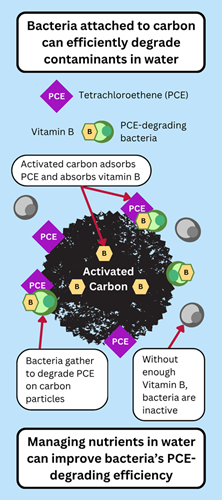
Dual-Action Bioaugmented Sorbents Optimize Groundwater Cleanup: Researchers at the University of Maryland Baltimore County developed an innovative method to clean up harmful chlorinated chemicals in water by combining activated carbon, which acts like a sponge to capture contaminants, with specialized bacteria that break them down. Using a new computer model, they were able to accurately predict how well this combined approach works in different scenarios to boost the technology’s performance.
Linking Early-Life Lead Exposure with Cognitive Function Later in Life: Higher lead exposure before birth is linked to lower cognitive function in older adulthood, particularly in women, according to a study from the Harvard School of Public Health. Using lead levels in shed baby teeth, scientists were able to pinpoint exposure timing and demonstrate its impact on brain health decades later.
New Tool Targets Complex Groundwater Pollutants: Scientists at SRP-funded small business Microvi Biotechnologies, Inc., developed a new technology that simultaneously houses and feeds bacteria that can degrade complex groundwater pollutants. According to the authors, this is the fastest breakdown of one of the target contaminants from just one bacterial strain, which would be crucial in cleaning up contaminated sites.
Building Better Models to Study Air Pollution and Lung Health: Oregon State University researchers developed a more realistic lab model of the human lung that combines airway cells and immune cells to better study the effects of air pollution exposure. The model showed stronger inflammatory responses to harmful chemicals compared to models using only one cell type or separated cells, which may help improve toxicity predictions.
Improving Chemical Cleanup of Contaminated Groundwater: Researchers at the University of California, Berkeley, studied how realistic conditions reduce the effectiveness of chemical oxidation methods for cleaning contaminated groundwater. Their work focused on how certain organic contaminants bind to soil particles which shield them from breakdown, offering insights to improve remediation strategies.
News Stories
Tracking Toxic Contaminants in Drinking Water: A Spotlight on Nicolette Bugher (Massachusetts Institute of Technology SRP Center): Nicolette Bugher, Ph.D., is a recent graduate and postdoctoral researcher at the Massachusetts Institute of Technology (MIT) Superfund Research Program (SRP) Center. Her research focuses on improving how scientists detect, quantify, and characterize N-nitrosamines, a class of potentially carcinogenic compounds found in drinking water supplies.
SRP-Funded Technology Provides Affordable PFAS Testing for Homeowners (Cyclopure): A mail-in test kit developed by SRP-funded small business Cyclopure is offering an affordable alternative to professional lab tests for PFAS in drinking water. Users fill a small collection cup with their water; the water drains through a filter disc that binds PFAS molecules, and only the compact disc is mailed back to the lab, where it is analyzed for 55 different PFAS compounds.
From Trainee to Faculty: Jitka Becanova's Journey in PFAS Research (University of Rhode Island SRP Center): Jitka Becanova, Ph.D., traces her career trajectory as well as her current research in detecting forever chemicals in aquatic environments. In a related project, she is working with her team to develop a tool to mimic how these chemicals accumulate in fish to better understand how they affect these aquatic environments, as well as improve forever chemical remediation efforts.
Computer Models Paired with Lab Studies More Accurately Predict PFAS Clearance (Texas A&M University): Researchers are exploring ways to use computer models to more closely predict how our kidneys remove PFAS from the body. Because chemicals vary in molecule size, current computer models are not entirely accurate. To resolve this, the team is pairing new models with current data of kidney cells to improve predictions.
Massachusetts Institute of Technology: 3D Cell Model for Testing DNA Damage (Massachusetts Institute of Technology SRP Center): Scientists developed a new platform to rapidly test DNA damage. Called the SpheroidChip, their tool can grow 3-dimensional cells or spheroids and analyze them for DNA damage all in one platform, increasing efficiency and accuracy over traditional approaches.
Building Materials a Primary Source of Airborne PCBs in Vermont Schools (University of Iowa SRP Center): Researchers worked with schools in Vermont to identify three building materials as main sources of airborne pollutants called polychlorinated biphenyls (PCBs). In particular, they found fireproof coating, glass block windows, and joint caulk sealants as significant sources of PCBs.
Examining Best Methods to Analyze Different Chemical Mixtures (North Carolina State University SRP Center): Researchers reviewed the best statistical tools for studying how real-world chemical mixtures affect health. They reported that newer specialized methods work better for more complex chemical exposures, but simpler traditional approaches may perform better for straightforward cases.

Picoyune: From Trainee Superfund Project to Small Business (University of California, Berkeley SRP Center; Picoyune): Jay James, Ph.D., launched a small business grounded in his research as an SRP trainee at UC Berkeley. Picoyune offers low-cost sensors to track personal exposure to mercury.
Remembering Bruce Hammock, Longtime SRP Grantee (University of California, Davis SRP Center): SRP remembers Bruce Hammock, a long-time grantee and UC Davis SRP Center Director for nearly 40 years, who passed away on January 5, 2026. A brilliant scientist and mentor, his groundbreaking work in toxicology, entomology, and environmental health left a lasting impact on the field.
to Top