




Superfund Research Program
By Mali Velasco
The legacy of uranium mining in the Southwest remains a major environmental health problem for Tribal communities. Although mining ended decades ago, waste from these sites continues to affect water, soil, dust, plants, animals, and people living nearby.
The University of New Mexico (UNM) METALS Superfund Research Program (SRP) Center was created to study these exposures and their health effects. The center brings together environmental scientists, engineers, biomedical researchers, and community engagement specialists to understand how metal mixtures move through the environment, how they affect the body, and how to reduce associated health risks.
The Problem
From 1944 to 1986, nearly 30 million tons of uranium ore were mined on Navajo lands. Many Navajo people worked in the mines while living and raising families near the mines and mills. Although the mines are now closed, the abandoned sites left behind contaminated soils, polluted water, and waste that continues to move through the environment decades later. On Navajo Nation alone, more than 500 abandoned uranium mines remain, including the Jackpile-Paguate Mine in the Pueblo of Laguna, which was formerly the largest open-pit uranium mine in the world. Tribal members continue to live near these sites, grow food, raise livestock, haul water, and maintain personal relationships with places altered by mining.
These exposures have been associated with a range of health effects, including cardiovascular disease, pulmonary dysfunction, immune-related effects, and kidney disease. Because contamination remains widespread and ongoing, reducing exposure requires long-term research, practical remediation strategies, and collaboration with affected communities.
SRP Solutions
The UNM METALS SRP Center studies how complex mixtures of uranium, arsenic, vanadium, and other metals move through water, soil, dust, plants, animals, and the human body. Researchers are examining how these exposures affect the lungs, gut, immune system, and DNA repair pathways. They are also developing intervention and remediation strategies, from clinical approaches to environmental cleanup methods using fungi and plants.
The center’s history goes back to the early 1990s, when Navajo community leaders approached UNM researcher Johnnye Lewis, Ph.D., with concerns about whether uranium in unregulated drinking water might be contributing to unusually high rates of kidney disease in their communities. That question helped launch the long-term NIEHS-supported research efforts that later became the UNM METALS Center. Lewis led the Center from 2017-2022.
Trust Made Science Possible
“This work could not begin with sample collection alone. Building trust came first.” said Center Director Jose Cerrato, Ph.D.
At Laguna, building that trust took years. It required repeated meetings with Tribal leadership, environmental staff, and community members; working through Tribal review processes and data agreements; and patience.
“The center does not go in with a fixed checklist. Instead, research questions develop as communities share concerns and ask questions,” explained Research Translation Coordinator and artist-in-residence Mallery Quetawki. “That process has helped shape not only how research is conducted, but also what research is prioritized.”
The center built trust through sustained presence and responsiveness. Staff and investigators meet directly with community members, Tribal officials, and departments such as Laguna’s Environmental and Natural Resources Department. They invite community participation in sampling and reporting activities and work with community advisory boards to determine how results should be shared.
“This work was not separate from the research. It made the research possible,” Cerrato explained. “Without it, the center would not have been able to move into human exposure and intervention studies.”
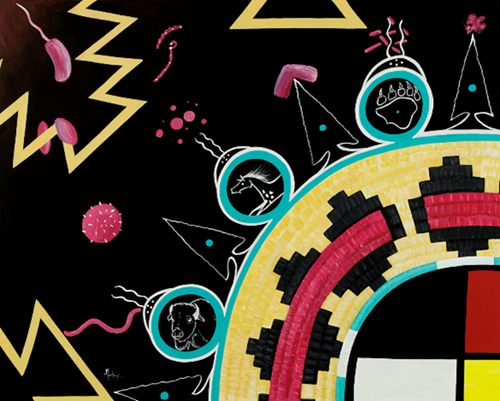
This painting depicts a healthy immune cell as a traditional Navajo basket surrounded by symbols of spiritual protection, including bear, war pony, buffalo, and arrowheads. (Image courtesy of Mallery Quetawki)
Art and Communication Support Trust Building
The center also found that standard scientific communication was not always effective in community settings. Technical language about cancer, DNA damage, and chronic illness can be difficult to understand and, in some cases, can be perceived as inappropriate or harmful.
“Spoken words can carry weight in Indigenous communities, especially when they focus only on damage or illness,” said Quetawki.
In response, the center developed a communication approach that uses art, storytelling, poetry, and visual explanation. Quetawki’s artwork has been used to explain DNA repair, immune protection, environmental exposure, and healing in ways that are more relatable to their practices and grounded in Indigenous traditions. Images often use butterflies, dragonflies, and floral motifs to communicate protection, regrowth, and balance.
“This work shows that community engagement is not separate from the science,” said Quetawki. “It is what allows the research to move forward and helps turn findings into strategies that can protect health.”
Environmental Research Informs Biomedical Studies
The center’s biomedical studies are based on environmental data collected from affected lands. Researchers first identify the metals and particles present in water, soil, and dust, then use those findings to design laboratory studies that reflect real-world exposures.
At Claim 28, a mine waste site located near the Blue Gap-Tachee community of the Navajo Nation, environmental studies documented uranium, vanadium, and other metals at levels that may cause cardiopulmonary toxicity. These findings helped add the site to the Navajo Nation’s Environmental Protection Agency clean up priority list. At Laguna, researchers and collaborators identified radionuclides and metals in surface water and sediments associated with the Jackpile-Paguate Mine area, including elevated radium in waters accessible to the public and livestock. The center has also collected water and dust data over multiple years to better understand local exposure conditions.
These findings directly shaped the center’s biomedical studies and are helping explain how mixed metal exposures may contribute to disease. For example, researchers used uranium-bearing dust collected from the Jackpile-Paguate Mine area and surface water collected upstream and downstream of the mine. They found that uranium-bearing dust changed how intestinal cells developed, especially certain cells involved in hormone signaling and mucus production. Other studies using mine-derived dust have linked metal exposure to neuroinflammation and immune responses.
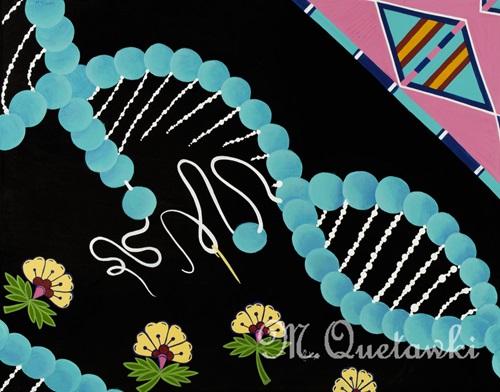
Quetawki’s painting, “DNA Repair”, illustrates how zinc can help repair DNA, like a jewelry-maker restrings beads to fix a broken necklace. (Image courtesy of Mallery Quetawki)
Thinking Zinc: A Mechanism-Based Intervention
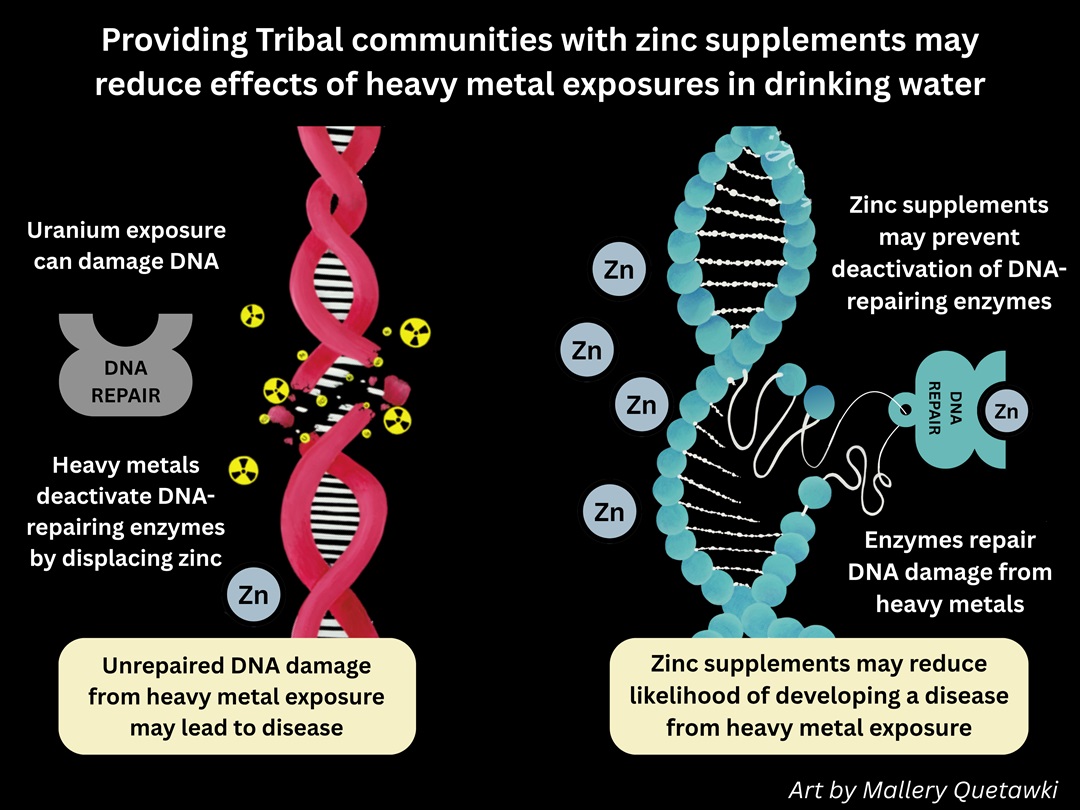
One of the center’s major intervention efforts is the Thinking Zinc clinical trial, which is evaluating whether zinc supplements can reduce biological markers of metals toxicity in the Navajo Nation.
The trial grew out of mechanistic studies showing that arsenic and uranium can displace zinc in zinc-binding proteins involved in DNA repair. When zinc is displaced, DNA repair is disrupted. This finding provided a possible explanation for how metal exposures contribute to longer-term biological damage — and a possible pathway for intervention.
Researchers then tested whether zinc supplementation might reduce some of these effects. In mouse studies, supplementing with zinc reduced arsenic concentrations in several tissues and altered expression of transporters involved in metal handling. Related studies also revealed that zinc may help reduce oxidative stress, inflammation, and other effects of metal toxicity.
Building on these findings, the center developed the Thinking Zinc trial with community input. Community advisors helped shape the study name, expand age eligibility, and support a one-arm longitudinal design in which all participants received the intervention. This design aligned with community preferences and built a foundation for trust. Informational materials were created in English and Diné, and the intervention was framed in a way that connected zinc to Indigenous concepts of balance and wellness.
Because zinc is low-cost and widely available, the trial may point to a practical strategy to help reduce health risks in communities living with long-term metal exposures.
First Biomedical Studies Approved at the Pueblo of Laguna
The center’s long-term relationship with the Pueblo of Laguna led to a major milestone in 2025, when the community approved the first biomedical studies designed to assess exposure and health impacts related to uranium mine waste. The protocol was developed in collaboration with the community through meetings with Tribal government, staff officers, the Tribal Historic Preservation Office Advisory Committee, and the Pueblo Council.
“The approval reflected years of relationship-building,” explained project leaders Laurie Hudson, Ph.D., and Debra MacKenzie, Ph.D. “The center had to show that it would not simply collect data and leave, and that community priorities would continue to shape the work.”
The Laguna Community Exposure Study is now underway, with 125 participants enrolled. The study collects blood and urine samples and includes health and exposure surveys. Related protocols support additional respiratory- and gut-focused studies, including exhaled breath condensate, nasopharyngeal swabs, and stool collection for microbiome analyses. The study is designed to better understand current exposures and biological responses in a community living near the Jackpile-Paguate Mine.
The study also reflects what the center has learned about exposures. Researchers found that metal mixture exposures vary across different people and over time. For that reason, the Laguna protocol includes repeated sampling and more detailed questions about outdoor activities, food sources, and recent behaviors that may affect exposure.