NIH HEW Data Accelerator
Many data challenges exist in environmental health and extreme weather research, for example:
- Data products not tailored for health research.
- Difficulty finding and accessing the right data.
- Exclusion of environmental health data from health record systems.
- Lack of computing and storage infrastructure to process data.
- Lack of data sets, code, and models to support health research.
- Lack of metadata, ontologies, common data elements, and standards.
- Lack of policies and guidance regarding use of environmental health data.
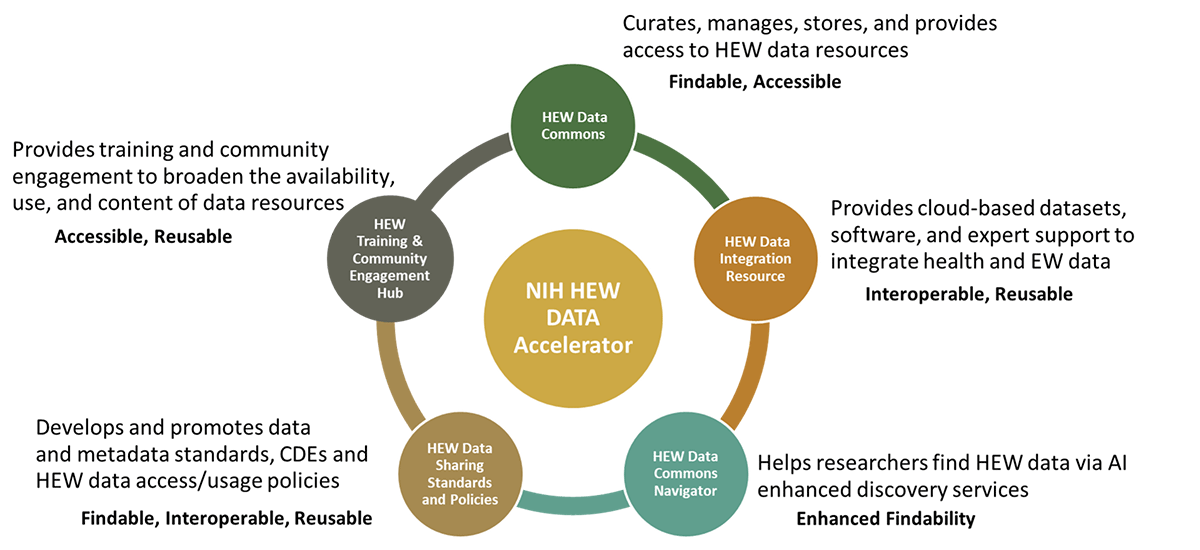
The main components of the NIH Data Accelerator Program will address these barriers and promote the ability to identify, access, integrate, and reuse environmental health data for research with Findable, Accessible, Interoperable, and Reusable (FAIR) and sustainable data investments.
What Will Be the Outcomes of the Data Accelerator?
- Data Commons to improve the ability to find and access appropriate environmental health-relevant datasets, software code, data models, surveys, educational materials, tutorials, etc. to support needed research.
- Data Integration Resource, such as software code and data models, needed to create interoperable computable data for linkage and integration of environmental data with health data.
- Data Navigator to facilitate discovery of available environmental health data and related resources using AI-based natural language interfaces.
- Data sharing standards and policies to support standardized metadata, ontologies, data models, common data elements, and governance policies to promote interoperability and reuse of linked environment and health data.
- Community Engagement Hub to advance training and education of health researchers to promote sharing and use/reuse of data resources.