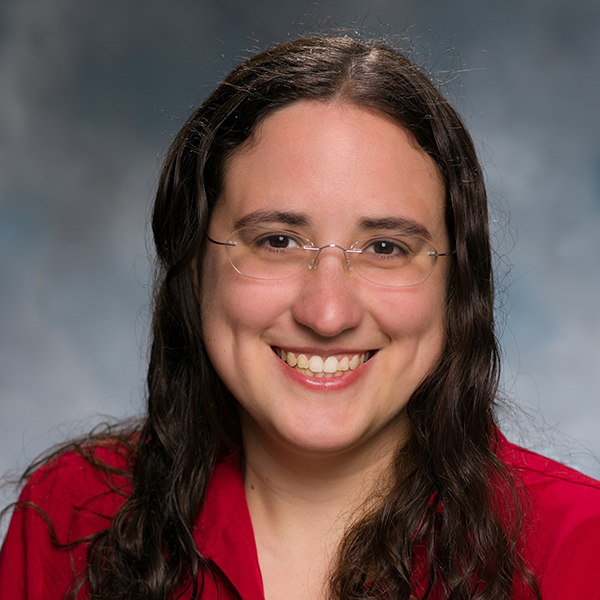
By tracking pollution in the environment, Allison Patton, Ph.D., hopes to improve the health of communities exposed to it.
“Tracking and mapping pollution can help people make the connection between what is in their environment and how they could be exposed,” Patton said.
Patton is particularly passionate about protecting communities from traffic-related air pollution. This interest grew out of her involvement with the Community Assessment of Freeway Exposure and Health Study (CAFEH) while pursuing her doctoral degree at Tufts University. CAFEH is a community-based participatory research project partly funded by NIEHS.
“As I was finishing undergrad and was looking for where to go next, I wanted to make sure that whatever I did made an impact on people’s lives,” Patton said. “I learned about what CAFEH was doing to understand how air pollution affects people’s health, and I knew I had found my next move.”
Now a senior scientist at the Health Effects Institute, Patton oversees studies related to understanding and tracking air pollution emissions from traffic to inform strategies to improve air quality and public health.
Modeling Air Pollution
Patton’s work with CAFEH began during the project’s early stages. The Boston-based team was studying if exposure to the smallest air pollution particles, called ultrafine particles, near highways was associated with cardiovascular disease risk.
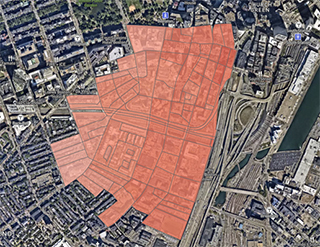
“We had a mobile laboratory, and we drove around neighborhoods near Interstate 93 and measured ultrafine particles at different times of the day, across several years,” Patton explained. “Then, we took those measurements, as well as location relative to busy roads, data on wind speed and direction, temperature, and the amount of traffic at a given time, and made models to predict community exposures.”
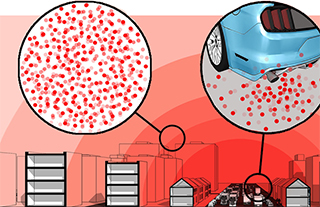
Notably, the team’s models revealed that air pollution exposure cannot be generalized across neighborhoods, even if they have similar levels of traffic pollution from the nearby highway. Patton noted that factors such as neighborhood elevation, buildings and other structures near the highway, and the placement of roads that lead to highway ramps play a role in the amount of air pollution people are exposed to in different communities.
In response to community concerns about air pollution exposures in the Chinatown area of Boston, which is located near two major highways, Patton helped the CAFEH team create an interactive online tool for health literacy that residents can use to visualize ultrafine particles.
Training in Action
Upon completing her doctoral degree, and with NIEHS support, Patton pursued postdoctoral research training at Rutgers University. There, she looked at differences in air pollution exposure for people driving on the New Jersey Turnpike compared to those driving on local roads.
In 2017, shortly after finishing her postdoctoral work at Rutgers, Patton joined the Health Effects Institute, a nonprofit organization that funds air pollution and health research to inform health-protective policies.
“In my role, I am involved in every step of the research process,” Patton explained. “I help identify what’s needed in an area of research, prepare requests for proposals, oversee the review of applications, and follow investigators along their research process, making sure that they have the resources they need.”
Upon completion of a study, Patton helps develop a short report that explains the study findings and limitations, plus what it means for its intended audience.
Informing Policy
Patton explained that CAFEH’s meetings to communicate study results to the community were often attended by policymakers.
“State and local representatives and others who regularly showed up to our public meetings or read our reports are now working on a new state regulation to install air filters in buildings near highways and increase the amount of air quality monitoring,” she said.
A study by Patton and team on how air pollution decreased at the beginning of the COVID-19 pandemic, when road traffic was minimal, also informed new policies by the City of Somerville, Massachusetts. The new policies aim to create programs that reduce traffic congestion and on-street parking shortages, to ultimately improve air quality and pedestrian safety.
Through her work at the Health Effects Institute, Patton leads science that directly answers questions from policymakers. For example, she oversees studies to understand non-exhaust emissions, which come from vehicle brake pads, tires, and roads themselves wearing down over time.
“Currently, regulations that limit non-exhaust emissions are just beginning to be proposed, mainly because we have limited information about the extent of these emissions,” Patton said. “I hope that, with our research, we can contribute to new policy discussions.”
Lessons Learned from Mentors and Collaborators
Patton is grateful for the mentors who guided her along the way. In particular, she fondly remembers her first mentor, the graduate student she worked with while pursuing her undergraduate degree at the Massachusetts Institute of Technology.
“She was studying how drinking water contaminated with arsenic was making people sick and I helped her with laboratory work,” Patton reminisced. “Seeing what she was doing inspired me to go to graduate school.”
Later, as a doctoral student, Patton enjoyed working with undergraduates who, like her, were passionate about future careers in science.
“Each of the undergraduates who worked with us had different interests and skillsets,” she said. “Some helped with modeling and others helped in our mobile lab. Helping them to further develop and use their skillsets was not just rewarding, but also fun.”
Another source of wisdom throughout Patton’s career has been the multiple community members who collaborated with her through the years.
“The different community groups we worked with [for CAFEH] had different purposes and expertise in diverse subjects that, taken together, improved the quality of our work,” Patton shared.
“Through conversations with partners I also learned the importance of communicating research to people in a way they can understand, as opposed to just publishing in scientific journals,” Patton explained. “We want to make sure we’re giving back to the residents who helped us, by sharing findings in a way they can use to take actions to protect their health.”
Allison Patton, Ph.D.