





Technology Profile
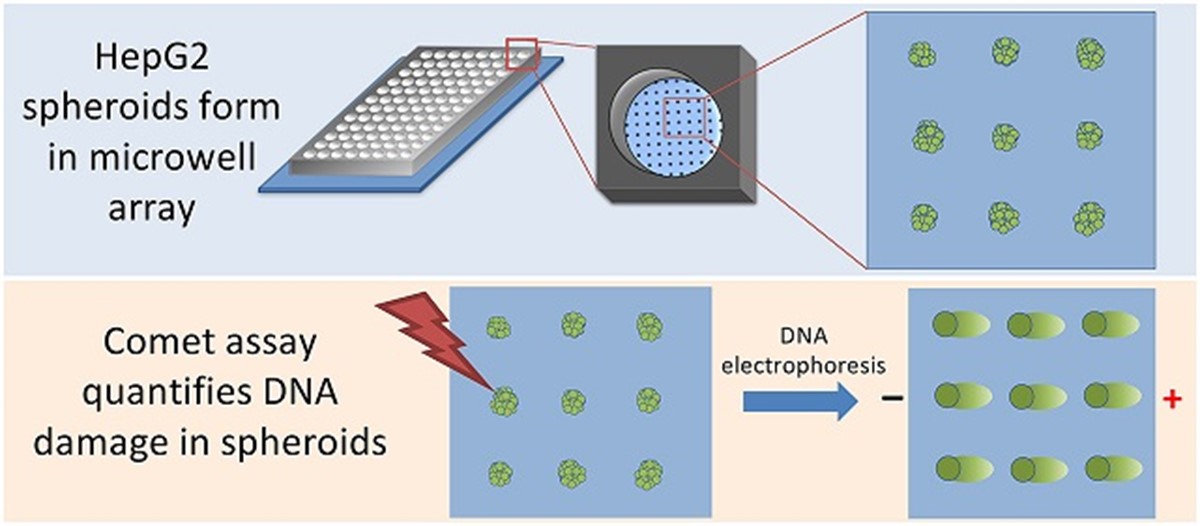
Scientists at the NIEHS-funded Massachusetts Institute of Technology (MIT) Superfund Research Program (SRP) Center developed the SpheroidChip, a novel platform for rapidly testing DNA damage.
DNA damage can increase the risk of cancer and other diseases. To study this, scientists are increasingly using three-dimensional (3D) cell models, or spheroids, which better mimic the natural environment of tissues. However, traditional methods for creating and testing these spheroids are often difficult and slow, and require breaking the spheroids apart — a step that can alter the results.
The SpheroidChip overcomes these limitations by using a single platform to grow dozens of spheroids and then analyze them for DNA damage on the very same chip, without disrupting the spheroids' structure. This new method offers a more accurate and efficient method for understanding how chemical exposures can lead to DNA damage and increase disease risk.
| Technology | The SpheroidChip platform uses agarose, a non-toxic material, to create microwell patterns at the bottom of a standard 96-well plate. Human liver cancer cells (HepG2) are loaded into these microwells, where the low-attachment environment causes them to self-aggregate into dozens of uniform spheroids. Once formed and stabilized with an agarose overlay, the intact spheroids are exposed to chemicals. The platform then integrates the high-throughput CometChip assay, previously developed by the MIT SRP Center, to assess DNA damage. This process involves electrophoresis, where an electric current pulls fragmented DNA through the agarose, creating a "comet" shape. The amount of DNA in the comet's tail is directly proportional to the level of DNA damage, which can be precisely quantified. Researchers successfully demonstrated this by detecting a dose-dependent increase in DNA damage in spheroids exposed to hydrogen peroxide. |
|---|---|
| Innovation | The SpheroidChip's primary innovation is its ability to perform the entire process — spheroid culture, chemical exposure, and DNA damage analysis — on a single, intact platform. Traditional comet assays require breaking the spheroids into single cells, a process during which significant DNA repair can occur, obscuring the true impact of the chemical exposure. By keeping the spheroids intact, the SpheroidChip allows for the accurate study of rapidly repaired DNA damage, which is crucial for understanding the effects of chemical exposures. In addition, the technology is low-cost and uses basic tissue culture supplies without the need for specialized equipment. |
| Contaminant and Media | Contaminant(s): Genotoxic chemicals, including inflammatory agents and other chemical contaminants that cause DNA damage. Media: In vitro 3D cell culture models (liver-cell spheroids). |
| Technology Readiness Level | TRL 4 – Component and/or breadboard validation in laboratory environment. |
| Principal Investigator | Bevin Engelward |
| Institution | Massachusetts Institute of Technology |
| Grant Number | P42ES027707 |
to Top