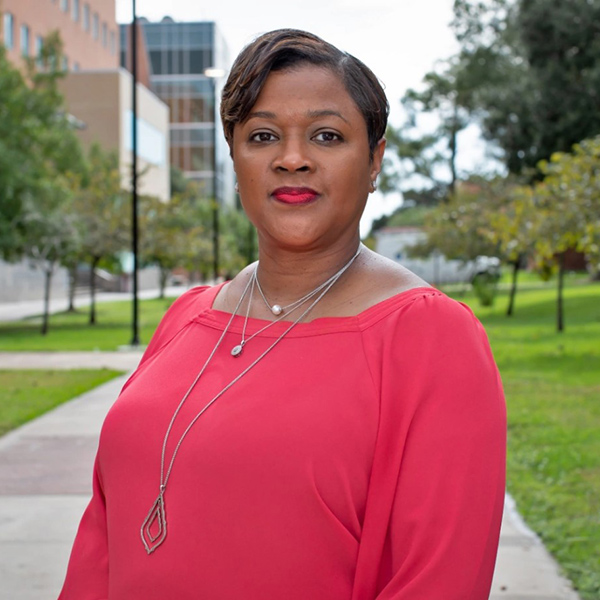
For as long as she can remember, Denae King, Ph.D., has been concerned about environmental health. Growing up in Houston, she had a front-row seat to a car-crushing facility across the street from her grandparents’ home. Watching the heavy machines smash vehicles into metal pancakes, she wondered what kind of contamination might be affecting her neighbors or her family.
Her concerns about industrial pollution only grew after the death of her grandfather, who worked as a pipe fitter on the Houston Ship Channel.
“He would come home wearing company-issued uniforms, take them off outside the house and put them in a bag, and then take them back to work the next day to get the next set of uniforms. Shortly after he retired, he died of a massive heart attack,” King said. “I was 15 at the time and thought that there must be something related to what he did at work that led to him being gone.”
Motivated by those memories, King forged a career in public health. Now an environmental researcher at Texas Southern University in Houston, she works primarily with communities — like the one she grew up in — that are exposed to industrial contaminants.
Building Capacity Within Communities
Among her roles, King is the associate director of the Bullard Center. Also located at Texas Southern University, the center is funded by private and federal institutions, including NIEHS.
“All the work we do is co-led by community members and designed to address community-identified concerns,” King explained. “We educate and train residents, and provide technical and financial support, to build capacity within communities to address those concerns.”
The center has several initiatives related to disaster response. They call it “multi-disaster work,” King noted, because many of the communities they work with are located near industrial facilities and are also vulnerable to natural threats such as hurricanes.
“We work closely with communities to make sure they have a plan when a disaster hits — that includes safe locations to go to, a list of residents to evacuate, and contractors that can go in and do repairs after the disaster,” King explained. “We also recently worked with community leaders to identify designated hubs within communities that have all the supplies a community might need, such as food, personal protective equipment, electricity generators, and tools needed to clear roadways in case of an emergency.”
Job Readiness Training
King is also devoted to raising employment. The Bullard Center provides training to unemployed individuals.
Through a 12-week-long program, the Bullard Center provides rigorous training that prepares participants for work in fields such as environmental cleanup, disaster response, and construction. After the training, staff, Paulette Lynch and Bertina Carter focus on getting participants placed in jobs. The program has a 92% success rate across all their sites.
King said, “We have had participants who were sleeping in their vehicles, people who were living in homeless shelters, or people who were previously incarcerated. And the transformation that you see from the first day to the end of the program, or a couple years later, is extremely rewarding.”
“Once someone is a member of the program, they are always members,” King continued. “If people want to change careers, or if there are changes with their job, they can always come back, and Bullard Center team members will help them find more placements.”
Protecting Black Mothers
Lately, King has incorporated a new focus into her work: maternal health. According to the Centers for Disease Control and Prevention, Black mothers in the U.S. are three times more likely to die from a pregnancy-related cause than White women.
What's driving those disparities is unclear. To explore potential reasons, in 2020, the Baylor College of Medicine and the Bullard Center launched the Maternal and Infant Environmental Health Riskscape Research Center. Co-led by Elaine Symanski, Ph.D., and Robert Bullard, Ph.D., the center is funded by NIEHS, the National Institute on Minority Health and Health Disparities, and the Eunice Kennedy Shriver National Institute of Child Health and Human Development.
“The impact of environmental exposures on maternal and infant mortality is not fully understood,” King said. “This project is helping us understand how some of the contaminants our communities are exposed to, such as lead and polycyclic aromatic hydrocarbons, affect mothers and their babies.”
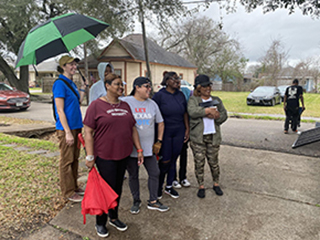
The center’s research includes participants from the same Houston community where King spent much of her childhood. The area is burdened by legacy contamination sites, King said, and contains a suspected cluster of birth defects and clusters of adult and childhood cancers.
“This work is still in its early stages, but one of our recent accomplishments is that we were able to collaboratively develop a community air monitoring program with our community partner, Coalition of Community Organizations (COCO), and the Environmental Defense Fund,” King said. “COCO purchased low-cost air monitors that measure PM2.5, and we worked collaboratively with COCO’s block captain program to strategically place them in locations across the Fifth Ward community to identify air pollution sources.”
Once they have more data, they’ll be a step closer to understanding local sources of pollutants and how they may impact maternal and infant health.
Denae King, Ph.D.