





NIEHS funds a substantial portfolio of research in the field of environmental health sciences conducted by investigators in many disciplines from various universities, organizations, and agencies These extramural research activities span the range from basic mechanistic research, research involving laboratory animal models and systems, to clinical and epidemiologic studies using human subjects. NIEHS-supported research is designed to determine how environmental agents cause or exacerbate a variety of human diseases and disorders. Grant applications are awarded and administered by the Division of Extramural Research and Training (DERT). In addition, certain applications – those from special solicitations – are reviewed in DERT, as well.
NIEHS is also committed to developing the next generation of environmental health scientists. The institute employs funding strategies aimed at introducing talented people at all educational levels to the fields of environmental health sciences and supports a variety of interdisciplinary training programs.
FY 2018 Grants Funding
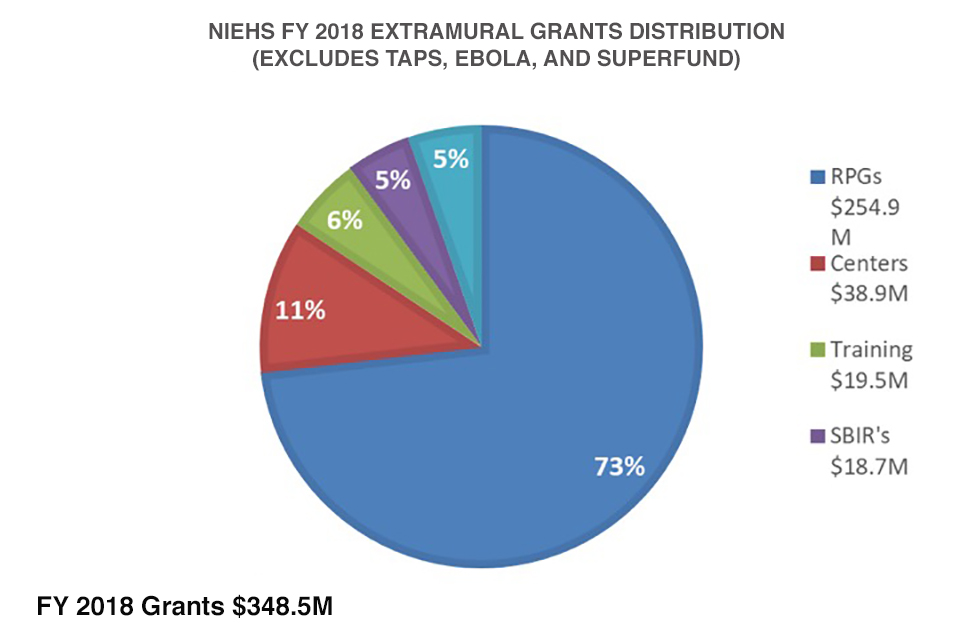
The total amount of the extramural grants funds awarded in FY 2018 was $348.5M (excluding taps, Ebola, and Superfund). The distribution of those funds is shown below. Information on NIH funding can be found at the NIH Office of Budget.
NIEHS FY 2018 Extramural Grants Distribution
(Excludes Superfund; dollars in thousands)
FY 2019
The Fiscal Year 2019 NIEHS appropriation provides for an overall budget for grants of $366.1M.
Funding Strategies
NIEHS makes its funding decisions based on scientific merit, program balance, responsiveness to the institute's priorities, and availability of funds. Special consideration is also given to applications from new and early stage investigators when making funding decisions. For additional information on NIH resources for new investigators, see Early Stage Investigator Policies.
Each year, following the appropriation of funds, an operating plan is developed that takes into account set-asides for specific initiatives and allocations for investigator-initiated applications.
-
Competing Awards
NIEHS allocates the majority of its research project grants funds to applications based on ranked percentile/priority score order. For FY2019, NIEHS has established a payline of 10% for investigator-initiated R01, R03, and R21 applications. In some cases, applications with scores outside this payline can be considered if, for instance, they are from Early Stage Investigators, if they address a high priority area in the NIEHS Strategic Plan, or to continue a previously supported resource.
For the most current information, you are encouraged to check with the appropriate Program Officer.
-
Noncompeting Awards
In FY 2019 all noncompeting grants are being issued at 100% of the total competing commitment levels for all out years. See Notice of Fiscal Policies in Effect for FY 2019.