NIH Program on Health and Extreme Weather launches new website
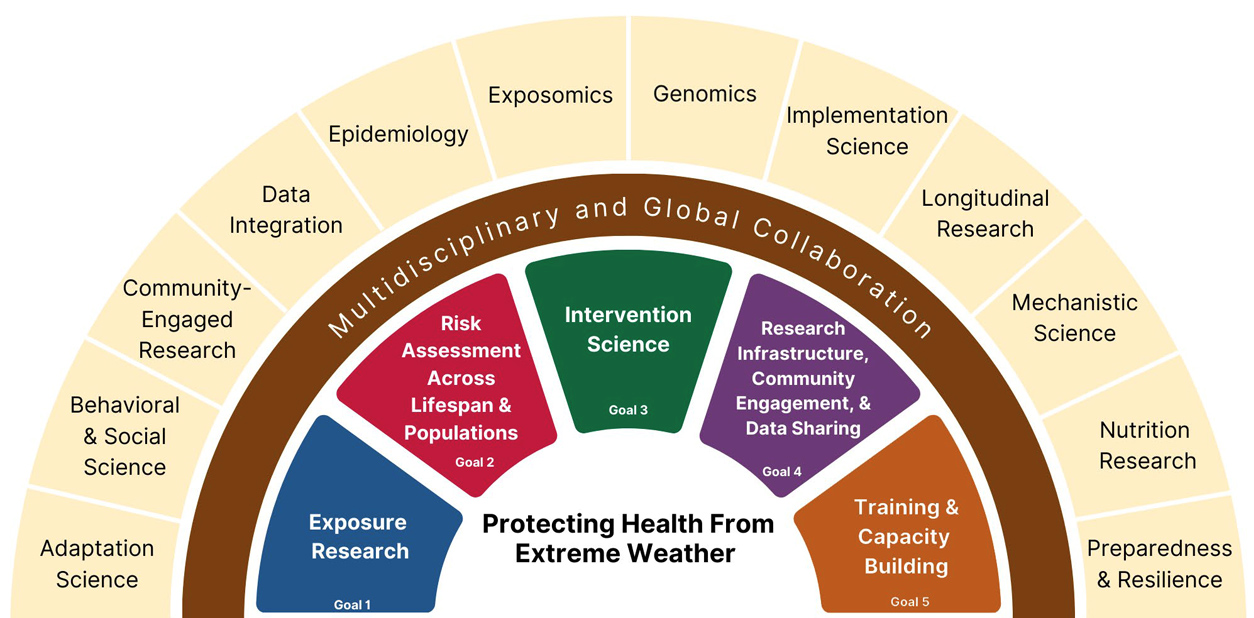
The National Institutes of Health (NIH) Program on Health and Extreme Weather (HEW) launched a new website offering a centralized hub for research, tools, and outreach materials. Researchers, policymakers, and members of the public can now access actionable information on how extreme weather events – such as heat waves, wildfires, and floods – affect human health. Visitors to the site can learn about the program’s research activities, access data resources, and review the latest scientific findings about how extreme weather affects the health of communities. The HEW Program works in close collaboration with the long-standing NIH Disaster Research Response (DR2) Program, which provides tools and resources to improve health research capacity to respond to disasters across the nation. (SE)
Superfund Research Program launches virtual technology fair featuring promising small businesses
On Aug. 27, the NIEHS Superfund Research Program (SRP) and the Environmental Protection Agency hosted a Virtual Technology Fair for Small Business Innovation Research (SBIR) awardees. The event, conducted through the Contaminated Site Clean-Up Information platform, highlighted new tools for exposure assessment, computational modeling, and contaminant sensing.
Representatives from four SBIR-supported small businesses pitched their latest technologies, aimed at improving the detection and cleanup of heavy metals.
- ChemFinity Technologies – Co-founder Adam Uliana, Ph.D., described the company’s approach to recovering critical minerals and removing heavy metals from mining wastewater.
- Microvi Biotechnologies – Chief Innovation Officer Ameen Razavi discussed biological processes for chromium remediation.
- OndaVia – CEO Mark Peterman, Ph.D., highlighted development of an autonomous in-line monitoring system for hexavalent chromium in drinking and ground water.
- Picoyune – Co-founder Jay James, Ph.D., introduced a plasmonic sensor and field monitor for mercury detection.
“SRP support for universities and small businesses helps decrease exposure to contaminants, reduce cleanup costs, solve complex environmental health problems, and, ultimately, improve human health,” said Heather Henry, Ph.D., a health scientist administrator in the SRP Hazardous Substances Research Branch. (JY)
Join the SMARTER webinar
Currently, there are no standards for gathering environmental health exposure data across domains and temporal and spatial scales. Making this “metadata” reusable by systematizing data properties and acquisition methods is essential for streamlining ongoing research.
The Sensors and Metadata for Analytics and Research in Exposure Health (SMARTER) project is designed to harmonize metadata to make it accessible to scientists working in different environments.
The NIEHS Office of Data Science is hosting a Dec. 12 webinar through the Environmental Health Language Collaborative to provide an update on SMARTER, featuring talks by two University of Utah professors: Mollie Cummins, Ph.D., professor of nursing and biomedical informatics; and Ram Gouripeddi, assistant professor of biomedical informatics and an assistant director of informatics at the Clinical and Translational Science Institute. Join the webinar on Dec. 12 at 2 p.m. (JY)
(Samantha Ebersold is a communications specialist in the NIEHS Office of Communications and Public Liaison. John Yewell is a contract writer for the NIEHS Office of Communications and Public Liaison.)