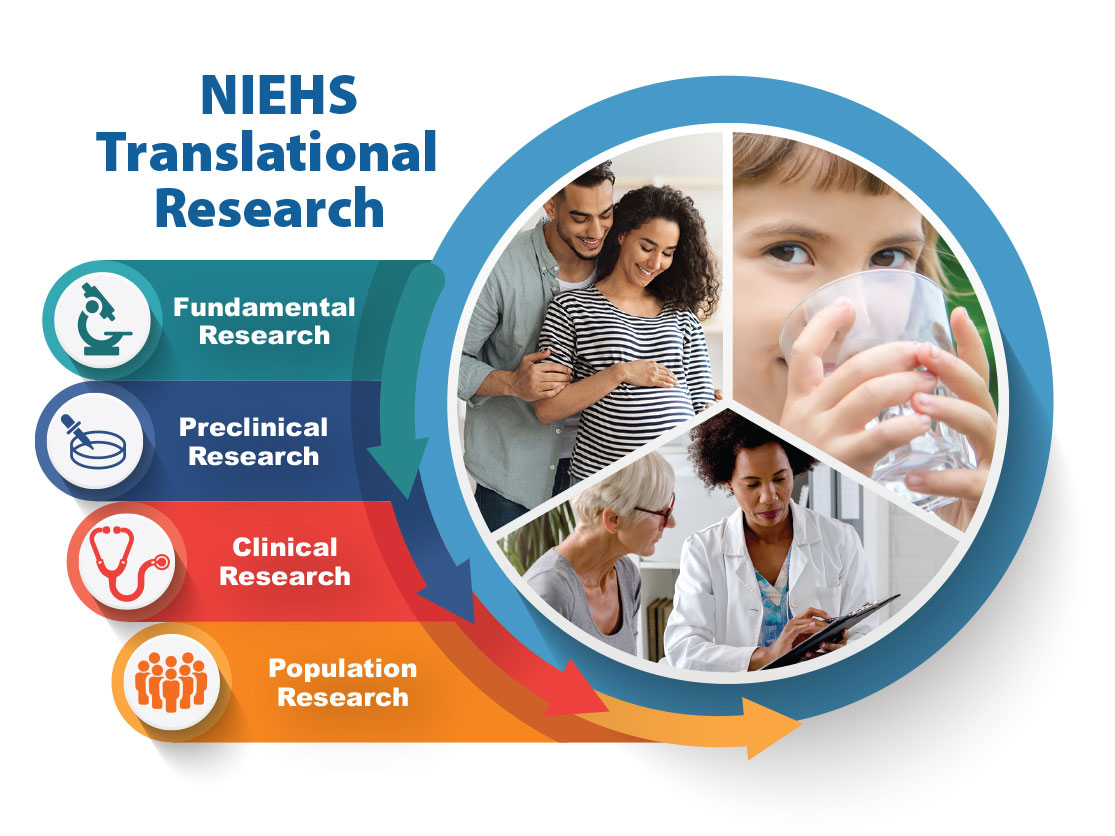
Scientific discovery rarely follows a straight path. A new insight in the laboratory may inspire preclinical experiments, guide clinical studies, and, ultimately, shape strategies for preventing disease at the population level. Just as often, observations gathered in communities or the environment raise questions that send scientists back to the lab bench for answers. This interplay is essential for environmental health, where exposures are complex, effects may span generations, and solutions demand collaboration across disciplines.
The cycle of discovery and application is the essence of translational research — and NIEHS plays a critical role in advancing it.
“Our institute is in a unique position to merge population science with fundamental laboratory research while harnessing innovative technologies,” said NIEHS Director Kyle Walsh, Ph.D. “By fostering collaborations that span multiple scientific areas, we can continue to leverage the knowledge we generate to prevent disease and maximize human wellness throughout the lifespan, from preconception to end of life.”
NIEHS conducts in-house research through its Division of Intramural Research (DIR) and Division of Translational Toxicology (DTT). Together, the divisions support a seamless research pipeline — one that uncovers how environmental exposures can affect fundamental biological mechanisms while also developing evidence to inform clinical practice, community health, and public policy. The institute also has a Division of Extramural Research and Training, which provides grant support to environmental health scientists at academic institutions across the country.
Building the knowledge base
Every scientific advance begins with a discovery. Fundamental or “basic” discoveries create the knowledge base that is essential for understanding how genetic and environmental factors together drive health and disease. Because these discoveries can take decades to translate into therapeutic targets or treatments, the private sector is often hesitant to invest in them. That’s where NIEHS comes in.
For example, Robin Stanley, Ph.D., studies the structural biology of RNA-protein complexes, which are critical for normal cellular function. Her team has shown how environmental agents disrupt these complexes, revealing potential pathways for disease and pointing to future therapeutic opportunities.
“When we uncover how biology works at the molecular level, we also open doors to new ways of safeguarding human health,” said Stanley.
Similarly, developmental biologist Humphrey Yao, Ph.D., explores how early-life exposures influence the developing reproductive system. His research points to biological “footprints” that can persist for decades and may help predict disease risk later in life.
“A glimpse into the fundamental processes that build organs in embryos deepens our understanding of how these events shape reproductive function and overall health in adulthood,” said Yao.
Such basic research has already led to clinical insights. Stavros Garantziotis, M.D., studies hyaluronan, a naturally occurring sugar that can contribute to lung scarring and impair breathing. His research has deepened the understanding of hyaluronan’s role in lung injury and inflammation — findings that are guiding approaches to protect and restore respiratory health in a Phase II clinical trial.
“Lab discoveries can quickly gain clinical relevance when we connect them to how patients respond to their environments and heal,” said Garantziotis.
Between discovery and application
Preclinical research in environmental health uses a variety of models to translate basic scientific understanding into a framework for preventing disease. These models include model organisms like zebrafish and mice, as well as complementary approaches, such as cell-based assays, organ-on-a-chip platforms, and computational models.
Paul Wade, Ph.D., uses mouse models to study how environmental exposures alter gene regulation. His team focuses on chromatin remodeling — the way DNA is packaged and made accessible inside cells — to understand how pollutants can incorrectly switch genes on or off. These studies shed light on molecular mechanisms that may increase disease risk.
“By looking at how exposures reshape the genome’s accessibility, we can pinpoint the earliest steps on the path from environment to disease,” Wade said.
Within NIEHS, DTT is developing new approach methodologies (NAMs) to reduce reliance on animal testing and improve the relevance of scientific findings to humans. For example, DTT scientists are devising organ-on-a-chip platforms, tiny devices lined with living human cells that mimic the structure and function of organs, such as the lung or liver. These chips allow scientists to study how chemicals affect specific organs in a controlled environment.
According to DTT Scientific Director Heather Patisaul, Ph.D., these approaches have the potential to be especially valuable for screening large numbers of chemicals and prioritizing those most likely to affect human health.
“That could greatly help zero in on the chemicals that matter most for public health,” said Patisaul.
The real world
Human studies connect lab findings to lived experience. The Clinical Research Unit (CRU) provides the infrastructure for intramural scientists to study human volunteers directly, ensuring that environmental health research remains grounded in real-world data (see CRU feature).
To find complex patterns in this data, Alison Motsinger-Reif, Ph.D., develops statistical and machine learning methods. Her work showed that participants in the Personalized Environment and Genes Study who lived near large pig farms were more likely to have autoimmune disorders, such as rheumatoid arthritis.
“We believe these methods will allow us to see how environmental exposures interact with genetic factors to contribute to a wide range of diseases, not just autoimmune diseases, but also heart disease, diabetes, and cancer, to name a few,” Motsinger-Reif explained.
Populations in focus
At the broadest scale, population science investigates how environmental exposures affect communities. NIEHS has long been a leader in this area, conducting large-scale studies that reveal patterns of risk and resilience.
Dale Sandler, Ph.D., leads the Sister Study, which tracks more than 50,000 women to understand environmental and genetic contributors to breast cancer. An example of their work linking long-term exposures to disease risk shows that exposure during both adolescence and adulthood to chemicals in personal care products, such as hair dyes and straighteners, may elevate breast cancer risk.
“Long-term studies give us the evidence to link environment, genes, and health across decades,” Sandler explained.
While Sandler’s team examines health outcomes across a lifetime, Kelly Ferguson, Ph.D., focuses on a much shorter time window: pregnancy. Her research applies epidemiological tools to study how exposures during this critical period affect maternal and child health. Ferguson’s studies have found that certain environmental chemicals, such as endocrine-disrupting compounds, can affect pregnancy outcomes and early childhood development.
“By studying real-world exposures, we can uncover trends that guide meaningful interventions to protect families,” said Ferguson.
DTT scientists also provide support to communities directly, quickly mobilizing in the aftermath of oil spills, chemical releases, and other disasters. Through the Responsive Research program, they provide rapid hazard evaluation, predictive toxicity screening, and decision support tools for public health agencies. (See Paper of the Month summary).
Such efforts to identify emerging contaminants and issues of concern, as well as safe and sustainable alternatives, complement DTT’s exposure-based and health effects research. The goal is to solve public health problems related to environmental exposures and develop evidence-based approaches to identify and understand potential environmental contributors to cancer, cardiovascular disease, and neurodevelopmental disorders.
The cycle continues
Although translational research is often portrayed as a linear process, NIEHS Scientific Director Darryl Zeldin, M.D., sees it differently.
“NIEHS research moves through multiple translational pathways, not just from the bench to the bedside, but to the community, to individual behaviors and choices, and to wider public policy changes and public health practice — and back again,” he said. “It’s a dynamic, interconnected, and constantly evolving spectrum, not a one-way street.”
(Marla Broadfoot, Ph.D., is a contract writer for the NIEHS Office of Communications and Public Liaison.)