For more than 22 years, NIEHS investigators have worked to uncover the causes of breast cancer through the Sister Study. The study follows a group of people, called a cohort, over time to investigate the genetic and environmental factors that influence the disease. While there are other large, long-term cohort studies focused on risk factors for breast cancer, the Sister Study was the first designed specifically to study the role of environmental factors and to focus on women who had a family history of the disease.
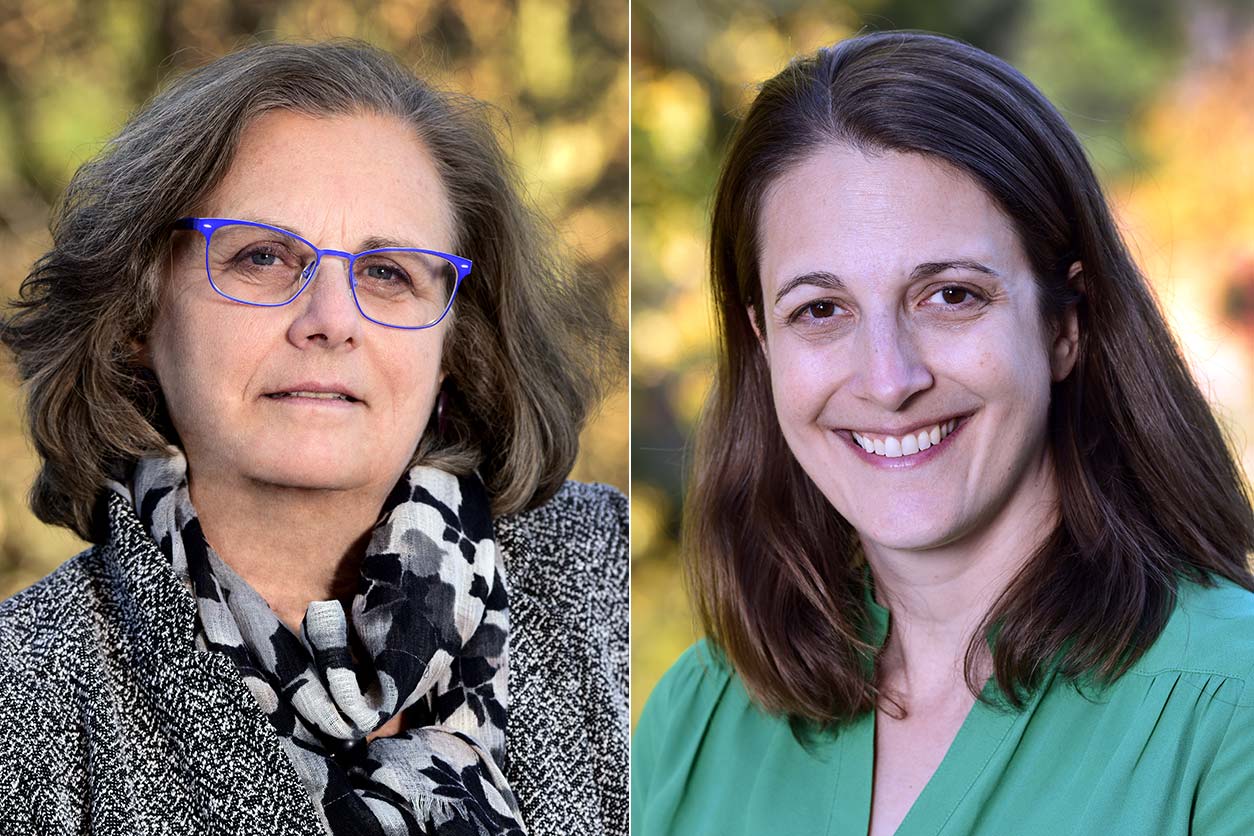
Dale Sandler, Ph.D., NIEHS senior investigator and chief of the Epidemiology Branch, developed the study with collaborator Clarice Weinberg, Ph.D., a principal investigator in the Biostatistics and Computational Biology Branch. Sandler, with current co-investigators Alexandra White, Ph.D., Stadtman investigator in the Epidemiology Branch, and Katie O’Brien, Ph.D., a staff scientist in the Epidemiology Branch, continues to lead the study.
O’Brien and Sandler spoke with Environmental Factor about what they have found and what’s ahead for the field.
1. Hormones, lifestyle, and environmental factors play a role.
O’Brien: The most important known risk factors for breast cancer are hormonally related. Factors such as the age you start menstruating, the number of children you have, and your history of oral contraceptive and hormone replacement therapy use are all related to breast cancer risk. Lifestyle factors, such as physical activity and obesity, also play a role, especially after menopause. The Sister Study was set up to look at environmental factors that could also contribute to risk.
Sandler: We study environmental factors in many different ways. One way is to ask participants about personal exposures, such as their use of personal care products, like hair dyes and straighteners, that may contain chemicals that disrupt hormones or act as carcinogens. Another way is to link participants’ residences to estimates of neighborhood and ambient exposures, such as air pollution. We also consider nonchemical exposures at the individual and neighborhood level, such as socioeconomic factors and characteristics of where people live. Importantly, we consider these exposures at different time periods, such as early life, during the reproductive years, and when women enrolled in the study. To look at more modern environmental chemical exposures, including PFAS, we can also measure chemical levels in biological samples. Alexandra White, Ph.D., is currently leading research to assess a large number of environmental exposures (called the “exposome”) in blood samples so that we may better study their potential health effects.
2. The Sister Study identifies environmental factors related to different types of breast cancer.
O’Brien: Our biggest contribution has been identifying previously unknown risk factors, including air pollution and exposures to chemicals in personal care products. For these and other factors, we consider how these factors relate to different types of breast cancer.
Sandler: We designed the study to enroll women who had a family history of breast cancer. The idea was that women with a family history of breast cancer have an enhanced risk themselves of developing breast cancer because of shared risk factors and shared genetic makeup. Out of 50,000 participants, 4,500 have developed breast cancer. That gives us statistical power to detect environmental exposures that may confer a small but meaningful risk. The absolute risk from fine particulate matter in air pollution, for example, is very small. But on the population level, it can have a large impact.
3. Exposomics allows researchers to examine chemical exposures.
O’Brien: Breast cancer rates have been increasing over time. After a 2002 study identified estrogen plus progestin hormone therapy as an important risk factor for breast cancer in postmenopausal women, many people stopped using it and the number of breast cancer cases dropped slightly for a short period. However, rates have continued to increase since then, indicating there are still some important risk factors we're not capturing. That's a big piece of why we think the environment is important.
Sandler: People are increasingly exposed to PFAS chemicals, phthalates, and plasticizers. I'm really excited about the line of research that Dr. White's group has opened up to look at these chemical exposures. This is our opportunity to see what people are exposed to today and what they were exposed to in the past. Exposomics, which includes the use of a technique called mass spectrometry, allows us to simultaneously examine hundreds of chemicals using a single blood sample. This approach allows researchers to look for associations with known chemicals, but also to identify associations with agents that have not yet been recognized.
4. Research highlights the benefits of lifestyle changes, lowering personal exposures.
O’Brien: Women can make some changes to their lifestyle or behavior to lower their breast cancer risk. For example, we know alcohol consumption is associated with increased breast cancer risk, as are some types of hormone therapy. Obesity is associated with postmenopausal breast cancer. Environmental exposures, such as air pollution, are often hard to control at an individual level, but women can try to lower their personal exposure to certain chemicals by looking at what is in their personal care products, cleaning products, and food. For example, does it have added fragrances? Does it contain potential endocrine disruptors, such as phthalates, parabens, bisphenol A (BPA), or known carcinogens, such as asbestos, benzene, or formaldehyde? Was the food cooked in or wrapped in plastic? Our research hasn't identified specific chemicals as direct causes of breast cancer, but we think the ingredients in some of these products may be harmful.
Sandler: At the simplest policy level, better labeling would help people make informed choices about the products they use.
5. Studying the health effects of environmental contributors enables people to make more informed choices.
O’Brien: We are committed to uncovering new environmental contributors to breast cancer and will continue to study the health effects of a range of factors, from personal care products to hormone therapy to some of the new weight management medications. We hope our work helps identify harmful chemicals that should be removed, and more clearly defines the risks and benefits associated with other factors so that individuals can make more informed choices about their own health.
Sandler: Our research also aims to identify factors that are associated with reduced risk. For example, a recent paper suggested that even brief periods when women are not overweight or obese may help reduce their chances of developing breast cancer after menopause. My takeaway from the Sister Study is that we still haven't found the one singular smoking gun cause of breast cancer, and we are unlikely to find one. Even so, we are bringing attention to the important role of environmental exposures, especially during specific windows of susceptibility, to the importance of studying breast cancer subtypes, and to the complexity of breast cancer risk. There's way more to learn. But by following this cohort for so many years, we've opened the door to new research opportunities and discoveries, and we're learning at a faster clip the way the environment can contribute to breast cancer.
Citations:
Sandler DP, Hodgson ME, Deming-Halverson SL, Juras PS, D'Aloisio AA, Suarez LM, Kleeberger CA, Shore DL, DeRoo LA, Taylor JA, Weinberg CR; Sister Study Research Team. 2017. The Sister Study Cohort: Baseline Methods and Participant Characteristics. Environ Health Perspect 125(12):127003.
White AJ, Keller JP, Zhao S, Carroll R, Kaufman JD, Sandler DP. 2019. Air pollution, clustering of particulate matter components, and breast cancer in the Sister Study: A U.S.-wide cohort. Environ Health Perspect 127(10):107002.
Chang CJ, Young AS, Keil A, Mullins CE, Liang D, Zhao S, Jones DP, Hu X, Walker DI, White AJ. 2025. Novel and legacy per- and polyfluoroalkyl substances in humans: Long-term temporal variability and metabolic perturbations. Environ Int 201:109590.
Shiels MS, Haque AT, Berrington de González A, Camargo MC, Clarke MA, Davis Lynn BC, Engels EA, et al. 2025. Trends in cancer incidence and mortality rates in early-onset and older-onset age groups in the United States, 2010-2019. Cancer Discov 15(7):1363-1376.
Stevens VL, Priest J, Wilkerson J, D'Aloisio AA, Sandler DP. 2025. Weight cycling and cancer risk in the Sister Study. Am J Epidemiol; doi:10.1093/aje/kwaf191 [Online ahead of print 29 Aug. 2025].
(Susan Cosier is a contract writer for the NIEHS Office of Communications and Public Liaison.)