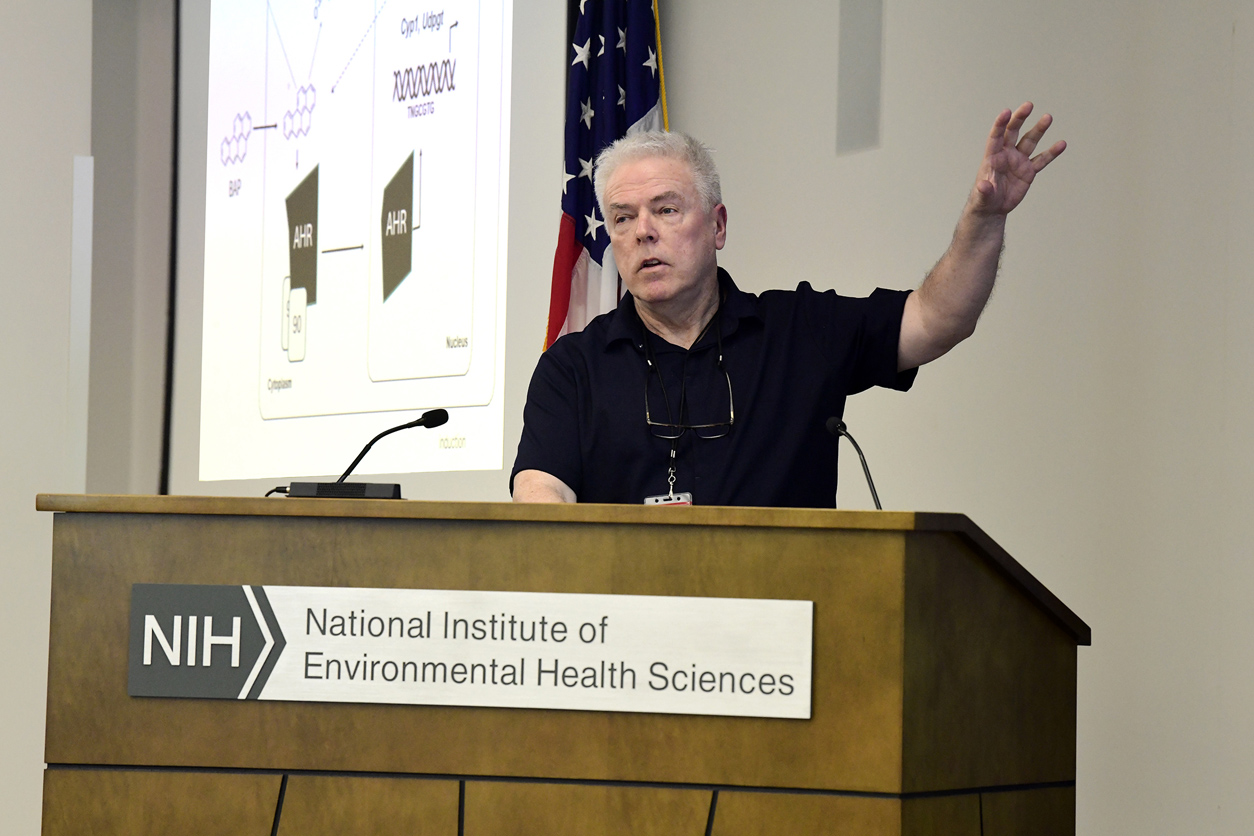
When scientists investigated why dioxins caused such severe health effects, they uncovered a key player in the body’s response to many toxic chemicals. Their work led to the discovery of the aryl hydrocarbon receptor, or AHR — a protein that acts as a molecular sensor inside cells. Decades later, AHR has become central to environmental health research, as Christopher Bradfield, Ph.D., explained during his Sept. 9 Keystone Science Lecture.
Research on this protein has revealed how chemicals can harm the body and how cells sense and respond to exposures.
“The AHR receptor is really the prototype for a superfamily of sensors,” said Bradfield, who directs the Biotechnology Center at the University of Wisconsin-Madison. “In large part, this is an environmental sensor family.”
The dioxin-AHR link
The history of AHR begins with one of the most well-known U.S. environmental health crises. The Love Canal disaster arose in the 1970s in Niagara Falls, New York, after a residential neighborhood and school were built on top of a toxic chemical landfill. Residents reported unusually high rates of birth defects, miscarriages, cancers, and other health problems. Public concern over chemical exposures helped drive the creation of the Superfund Act and the discovery of dioxin as a dangerous contaminant.
Later, NIEHS-funded studies showed that dioxin acts by binding a protein that was eventually identified as AHR. Bradfield was among the scientists who helped clone the receptor. According to NIEHS program officer Carol Shreffler, Ph.D., that breakthrough opened the door to exploring its broader roles in human health and disease.
“The AHR story is the perfect example of how the toxicology field has evolved from studying poisons to probing biology,” said Shreffler, who co-hosted the lecture with NIEHS health specialist Jennifer Collins.
Environmental sensors
Bradfield described how AHR was once viewed primarily for its role in chemical toxicity. But his research has shown that it is also an important signaling system with roles in immunity, barrier function, circadian rhythms, and host-microbiome interactions.
His laboratory’s animal models found that loss of AHR disrupted normal liver development, altered intestinal immune structures, and predisposed mice to kidney stones — evidence that the receptor influences multiple organs. These findings mirrored earlier observations that dioxin’s harmful effects were widespread, from cancer to immune dysfunction.
The AHR is now recognized as part of a larger family of environmental sensors called the PAS family that responds to oxygen, light, and other cues. These sensors act like a switch: When certain stimuli, such as dioxins or other pollutants, attach to them, they move into the cell’s nucleus and change which genes are turned on or off. Bradfield said this network connects toxicology with circadian biology and stress signaling, highlighting the receptor’s broad biological significance.
From toxicants to therapies
A big question in the field was why the human body has a receptor for a chemical that does not occur naturally but is instead an unwanted by-product of industry. Bradfield and AHR researchers around the globe found that the body produces natural molecules from tryptophan metabolism — either from diet or the microbiome — that actually bind to AHR. These molecules help maintain thin tissue barriers in the gut, lung, and skin.
“The receptor’s real role is to help protect us from pathogens and maintain barrier integrity,” Bradfield explained. “Dioxin hijacks that system.”
AHR also has emerged as a therapeutic target. In 2022, the U.S. Food and Drug Administration approved the first AHR-targeting drug for the chronic skin condition psoriasis, demonstrating how a receptor discovered through toxicology can be harnessed to treat disease.
Sharing resources
Over the last 40 years, Bradfield’s laboratory has generated a wealth of reagents, including genetically modified mouse models, plasmids, and tissue samples. To ensure these resources remain available for future generations, his group has begun digitizing them and assigning non-fungible tokens (NFTs) on blockchain platforms. Each token documents the provenance and genome sequence of a shared animal model or reagent.
“This is about decentralizing access,” said Bradfield. “If we can preserve resources in a way that is transparent and durable, young scientists won’t have to start from scratch.”
(Marla Broadfoot, Ph.D., is a contract writer for the NIEHS Office of Communications and Public Liaison.)